
Cervical Cancer
Einstein Health Glossary
ICD 10 - C53

ICD 10 - C53
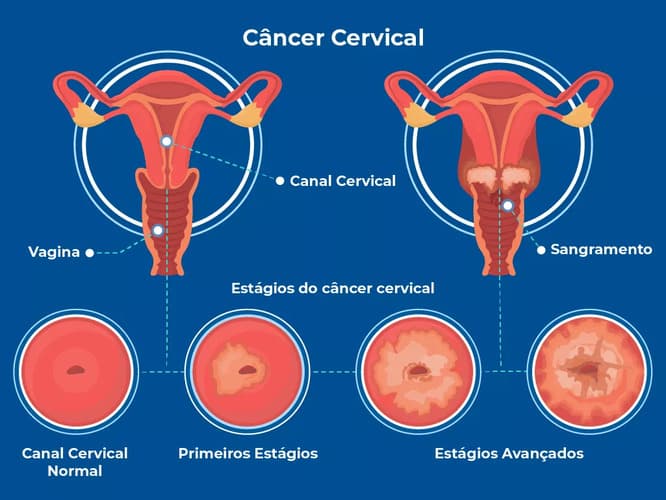
Cervical cancer, also known as cervical carcinoma, is a type of cancer that develops in the cells of the lower part of the uterus (the cervix). It occurs when these cells begin to multiply uncontrollably.
Most cases of cervical cancer are linked to infection with the human papillomavirus (HPV), which has a high prevalence in Brazil. For this reason, it is the most common gynecological tumor among the Brazilian population.
According to estimates from the National Cancer Institute (INCA), between 2023 and 2025, more than 17,000 new cases of the disease are expected, representing approximately 15.38 cases per 100,000 women.
The symptoms of cervical cancer can vary depending on the stage of the disease. In the early stages, it may not present any visible symptoms. As the disease progresses, the following symptoms may appear:
It is important to note that these symptoms can also be related to other health conditions. Therefore, if any of these symptoms appear, it is essential to consult a healthcare professional for proper evaluation and diagnosis
Cervical cancer is primarily caused by infection with the human papillomavirus (HPV). However, there are other risk factors that may contribute to the development of this type of cancer:
Methods for identifying cervical cancer are essential for detecting the disease in its early stages (when it may not yet cause symptoms) and for reversing lesions that could potentially become cancerous (pre-malignant)
These are the main screening methods used:
It is important for women to discuss with their healthcare providers which screening methods are most appropriate for them based on age, medical history, risk factors, and public health guidelines
The treatment for cervical cancer depends on the stage of the disease (whether it is localized in the cervix or has spread to nearby or distant organs), as well as the patient’s overall health and desire to become pregnant
Treatment options include:
Einstein’s Oncology and Hematology department offers comprehensive care from diagnosis through treatment. Learn more
The primary way to prevent cervical cancer is through HPV vaccination
In Brazil’s public healthcare system (SUS), the quadrivalent vaccine (which protects against HPV types 6, 11, 16, and 18) is available for boys and girls aged 9 to 14. As of 2024, the vaccination is administered in a single dose, with eligibility extended to adolescents up to 19 years old who have not yet been vaccinated
Additionally, in the public system, the quadrivalent vaccine is also available for immunocompromised men and women up to 45 years old (those with weakened immune systems due to illness, medication, or medical procedures) and for victims of sexual violence
In the private healthcare sector, men and women aged 9 to 45 can receive the nonavalent vaccine, which protects against 9 HPV subtypes and offers up to 90% protection against cervical cancer
Besides HPV vaccination, other preventive measures should be encouraged, such as maintaining a healthy immune system, not smoking, and regularly undergoing preventive screenings
BRITO-SILVA, Keila et al. Integralidade no cuidado ao câncer do colo do útero: avaliação do acesso. Revista de Saúde Pública, v. 48, p. 240-248, 2014
NAKAGAWA, Janete Tamani Tomiyoshi; SCHIRMER, Janine; BARBIERI, Márcia. Vírus HPV e câncer de colo de útero. Revista Brasileira de Enfermagem, v. 63, p. 307-311, 2010
SILVA, Mikaela Luz et al. Conhecimento de mulheres sobre câncer de colo do útero: uma revisão integrativa. Brazilian Journal of Health Review, v. 3, n. 4, p. 7263-7275, 2020
Explore health-related content and expand your knowledge:

A disease characterized by the uncontrolled growth of abnormal cells in the body [...]
A disease characterized by the uncontrolled growth of abnormal cells in the body [...]

The science that studies different types of cancer in the human body, including diagnosis and treatm [...]
The science that studies different types of cancer in the human body, including diagnosis [...]

Originates in the cells of the liver, an essential organ for detoxification and metabolism [...]
Originates in the cells of the liver, an essential organ for detoxification and metabolism [...]
A disease characterized by the uncontrolled growth of abnormal cells in the body [...]
A disease characterized by the uncontrolled growth of abnormal cells in the body [...]
The science that studies different types of cancer in the human body, including diagnosis and treatm [...]
The science that studies different types of cancer in the human body, including diagnosis [...]
Originates in the cells of the liver, an essential organ for detoxification and metabolism [...]
Originates in the cells of the liver, an essential organ for detoxification and metabolism [...]