
Meniscus Injury
Health Glossary – Einstein
ICD 10 - S83.2

ICD 10 - S83.2
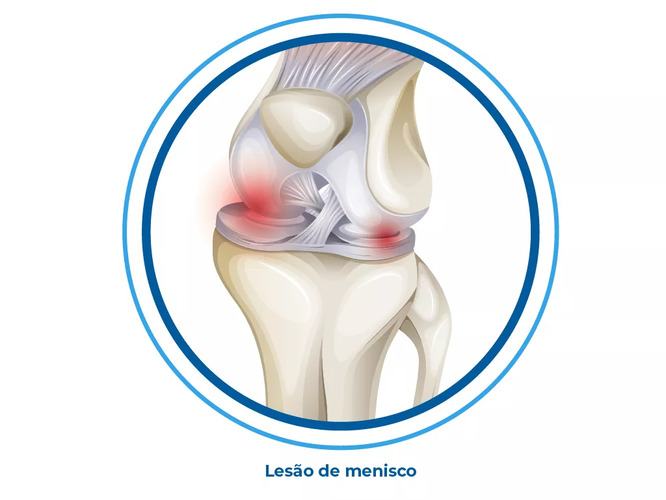
The menisci are crescent-shaped fibrocartilaginous structures, with a rubber-like consistency, located between the femur and the tibia.
Each knee has two menisci: the medial meniscus (on the inner side of the knee) and the lateral meniscus (on the outer side). Their main function is to distribute the load that passes through the joint, helping to reduce pressure on the cartilage that covers the bones in the knee. In other words, they act like shock absorbers, protecting this cartilage.
A meniscus injury compromises this protection and exposes the cartilage to wear, facilitating the development of osteoarthritis in the joint
Symptoms of a meniscus injury may include:
Meniscus injuries can be caused by a variety of events or conditions that result in excessive forces or abnormal movements in the knee:
Diagnosing a meniscus injury may include:
Treatment for a meniscus injury may vary depending on the severity of the injury and the patient's symptoms. Treatment options include:
Preventing meniscus injuries involves adopting several measures to reduce the risk of damage to this essential cartilaginous structure in the knee. Here are some important prevention strategies:
Brazilian Society of Orthopedics and Traumatology (SBOT)
Instituto Trata – Knee and Hip Institute
Health on the Podium: a project that addresses concepts, curiosities, and clarifies doubts about sports practice, performance, mental health, and well-being during one of the world’s largest sporting events.
You may also be interested in reading about:

difficulty performing certain physical activities, especially those that require quick movements and [...]
difficulty performing certain physical activities, especially those that require quick mov [...]

can be described in various ways, according to their duration (acute or chronic), size (partial, ful [...]
can be described in various ways, according to their duration (acute or chronic), size (pa [...]

a group of genetic diseases that cause progressive weakness and loss of muscle mass. The most common [...]
a group of genetic diseases that cause progressive weakness and loss of muscle mass. The m [...]
difficulty performing certain physical activities, especially those that require quick movements and [...]
difficulty performing certain physical activities, especially those that require quick mov [...]
can be described in various ways, according to their duration (acute or chronic), size (partial, ful [...]
can be described in various ways, according to their duration (acute or chronic), size (pa [...]
a group of genetic diseases that cause progressive weakness and loss of muscle mass. The most common [...]
a group of genetic diseases that cause progressive weakness and loss of muscle mass. The m [...]