
Toxoplasmosis
Einstein Health Glossary
ICD 10 - B58

ICD 10 - B58
Toxoplasmosis is an infection caused by a parasite called Toxoplasma gondii, found in the feces of cats, tigers, lions, and other wild felines. It can infect humans and other animals. Toxoplasmosis is generally asymptomatic in healthy individuals but can be serious in specific cases, such as in pregnant women and people with weakened immune systems.
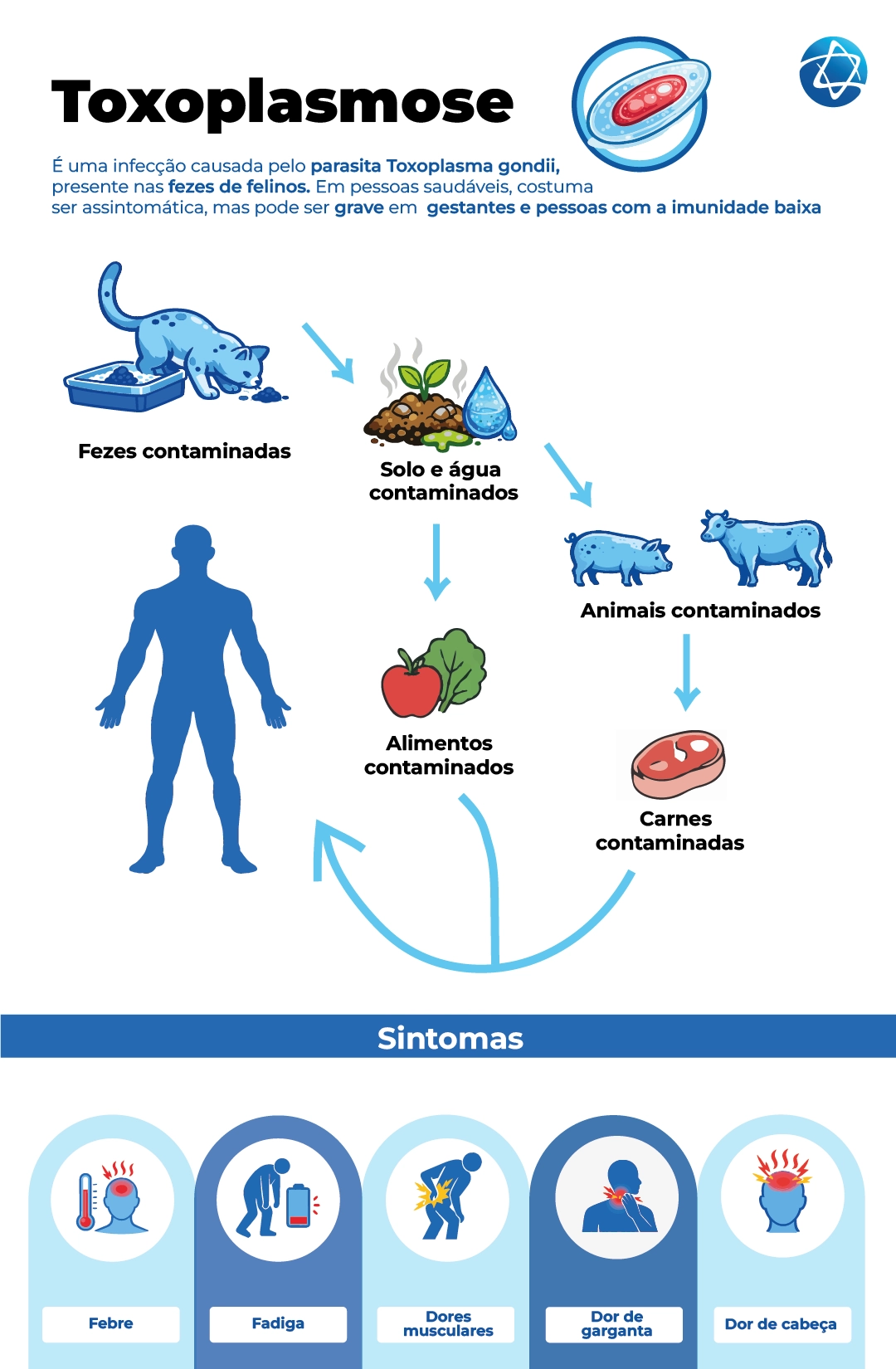
Toxoplasmosis is usually asymptomatic in healthy adults. When symptoms do occur, they may resemble those of mild viral infections, such as the flu, and include:
Severe forms of the disease can affect different parts of the body, such as the central nervous system, causing long-lasting problems in that area. In addition to the symptoms mentioned above, complications may lead to lasting effects.
Toxoplasmosis is caused by the parasite Toxoplasma gondii, and the disease can be contracted through actions such as:
It is important to emphasize that the disease does not occur solely through contact with cats or healthy felines.
The diagnosis of toxoplasmosis generally includes:
Toxoplasmosis usually progresses without lasting effects in people with strong immune systems (those with healthy habits such as good nutrition and overall wellness practices). In such cases, treatment is typically limited to managing symptoms. Individuals with weakened immunity should be referred for specialized medical care.
Treatment and follow-up for the disease are available free of charge and comprehensively through the SUS (Unified Health System). It is important to highlight that in cases of toxoplasmosis during pregnancy, prenatal monitoring is essential.
Preventing toxoplasmosis involves adopting hygiene practices and behaviors that reduce the risk of infection. Some appropriate measures include:
Read health content and expand your knowledge:

A disease caused by the parasite Trypanosoma cruzi, present in the feces of the triatomine bug (kiss [...]
A disease caused by the parasite Trypanosoma cruzi, present in the feces of the triatomine [...]

A viral disease transmitted by the bite of Aedes mosquitoes, especially Aedes aegypti
A viral disease transmitted by the bite of Aedes mosquitoes, especially Aedes aegypti

A disease caused by Leishmania parasites, transmitted by the bite of infected vector insects
A disease caused by Leishmania parasites, transmitted by the bite of infected vector insec [...]
A disease caused by the parasite Trypanosoma cruzi, present in the feces of the triatomine bug (kiss [...]
A disease caused by the parasite Trypanosoma cruzi, present in the feces of the triatomine [...]
A viral disease transmitted by the bite of Aedes mosquitoes, especially Aedes aegypti
A viral disease transmitted by the bite of Aedes mosquitoes, especially Aedes aegypti
A disease caused by Leishmania parasites, transmitted by the bite of infected vector insects
A disease caused by Leishmania parasites, transmitted by the bite of infected vector insec [...]