

What is bladder cancer?
Bladder cancer is a disease in which malignant cells (that grow in a disorganized way) form in the tissues of the bladder, an organ located in the lower abdomen responsible for storing urine produced by the kidneys before it is eliminated from the body through urination.
The most common type of bladder cancer is urothelial carcinoma, also known as transitional cell carcinoma, which begins in the cells lining the inside of the bladder.
Bladder cancer is the tenth most common cancer worldwide. There are different types, classified based on the type of cells where the cancer originates:
- urothelial carcinoma (transitional cell carcinoma): the most common type (accounting for up to 90% of bladder cancers in the United States and Western Europe), starting in the cells that line the inside of the bladder (urothelial cells)
- squamous cell carcinoma: less common and often associated with chronic irritation and bladder infections
- adenocarcinoma: also rare, this type develops in the glandular cells that secrete substances into the bladder
- small cell carcinoma: a rare type of cancer that develops in the bladder’s neuroendocrine (nerve and hormone-producing) cells
Symptoms
The most common symptoms of bladder cancer include:
- blood in the urine (hematuria): this is the most common symptom and may appear in small amounts or in excess, making the urine look pink, red, or brownish
- pain or burning during urination: the pain may occur before, during, or after urinating
- frequent need to urinate: feeling the urge to urinate even when the bladder is not full
- pain in the lower back or abdominal area
- difficulty urinating or a decrease in urine flow
- other symptoms: fatigue, weight loss, and loss of appetite (anorexia) may also be related to bladder cancer
Some of these symptoms may also appear in other conditions, including less serious ones, which can lead to delays in diagnosis. That’s why it is essential to consult a healthcare professional for an accurate and early diagnosis.
Causes
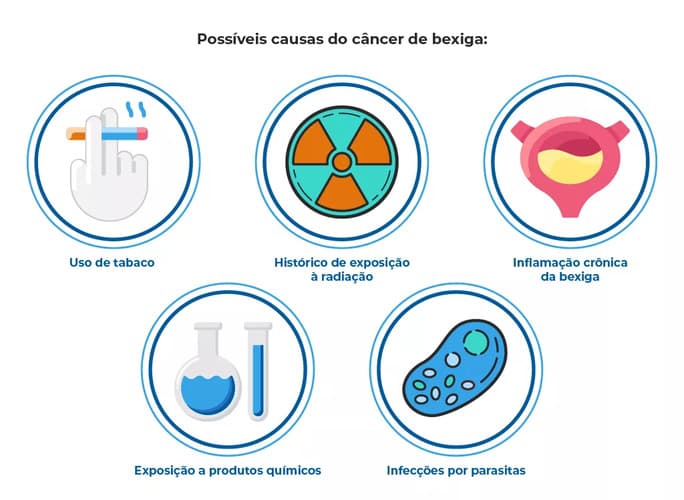
Not all causes of bladder cancer are fully understood. However, some common risk factors are known, such as:
- age and race: more common in older adults and in white men than in women
- exposure to chemical substances: workers in industries involving chemical compounds (such as aromatic amines, azo dyes, benzene, benzidine, among others) are at higher risk of developing bladder cancer
- smoking: smoking can triple the risk of developing bladder cancer
- chronic bladder irritation: frequent urinary tract infections or prolonged use of urinary catheters may increase the risk
- radiation and chemotherapy: previous treatments with radiation therapy or certain chemotherapy drugs may increase the risk
Diagnosis
The main methods used to diagnose bladder cancer include:
- urine test: a healthcare professional analyzes the urine for the presence of cancer cells and/or blood (which may indicate the need for further investigation)
- imaging tests: imaging test: exams that allow visualization of the inside of the body, such as computed tomography (which uses X-rays), magnetic resonance imaging (which uses a magnetic field), intravenous pyelogram (which uses X-rays with injected contrast), or cystoscopy (the “gold standard” procedure that allows visualization of the inside of the bladder and urethra and enables diagnostic biopsy)
Treatment
The ideal treatment is determined after diagnosis by healthcare professionals and depends on the stage of the disease. The most common are:
- surgery: it can be performed in three ways—removal of the tumor through the urethra (transurethral resection); partial removal of the bladder (partial cystectomy); or complete removal of the bladder (radical cystectomy), with the construction of a new organ to store urine (neobladder)
- chemotherapy: use of anticancer drugs that can be administered orally, intravenously, or directly into the bladder
- radiotherapy: use of radiation to destroy cancer cells or prevent them from multiplying
- immunotherapy: stimulates the body’s defense system (immune system) to attack cancer cells. Indicated in specific cases
Some of these treatments are performed before surgery and others afterward. Only a specialist in the field can determine the best treatment approach.
Einstein’s Oncology and Hematology Department offers comprehensive care from diagnosis to treatment. Learn more.
Prevention
The risk of developing bladder cancer can be reduced through some general health practices, such as:
- not smoking: smoking damages healthy cells in the body, making it easier for genetic mutations to occur
- avoiding secondhand smoke: inhaling smoke from another person is almost as harmful as smoking
- avoiding exposure to carcinogens in the workplace: occupations associated with an increased risk of bladder cancer include metalworkers, painters, rubber industry workers, leather workers, textile workers, miners, cement workers, transport operators, excavation machine operators, and jobs involving the manufacture of carpets, dyes, plastics, and industrial chemicals
- maintaining a healthy diet: including plenty of fruits and vegetables in your diet may help reduce the risk
- drinking plenty of water: increasing total fluid intake may help dilute carcinogenic substances and reduce their contact time with the urinary system
References
Health and Wellness
Read health-related content and expand your knowledge:

Specialty Explore Einstein’s Oncology Department
A medical field that studies different types of cancer in the human body, including diagnosis and tr [...]
A medical field that studies different types of cancer in the human body, including diagno [...]

Condition Learn how to prevent urinary tract infections
A condition caused by microorganisms that infect the urinary system [...]
A condition caused by microorganisms that infect the urinary system [...]

Condition Male urinary incontinence: causes
Involuntary loss of urine. It can affect daily activities, both during the day and at night [...]
Involuntary loss of urine. It can affect daily activities, both during the day and at nigh [...]

Explore Einstein’s Oncology Department
A medical field that studies different types of cancer in the human body, including diagnosis and tr [...]
A medical field that studies different types of cancer in the human body, including diagno [...]

Learn how to prevent urinary tract infections
A condition caused by microorganisms that infect the urinary system [...]
A condition caused by microorganisms that infect the urinary system [...]

Male urinary incontinence: causes
Involuntary loss of urine. It can affect daily activities, both during the day and at night [...]
Involuntary loss of urine. It can affect daily activities, both during the day and at nigh [...]