
Mpox
Einstein Health Glossary
ICD 10 - B04

ICD 10 - B04
Mpox is a disease caused by a virus belonging to the Orthopoxvirus family, the same group as smallpox. In the past, it was known as "monkeypox" because the virus was first isolated in 1958 in monkeys from a laboratory in Denmark that originated from the African continent, where the disease is endemic in some countries. The natural host and transmission cycle of the disease are still unknown, although rodents are believed to be the primary reservoir. The main form of transmission is through direct contact with an infected person via skin lesions. It can also be transmitted through contact with contaminated objects, clothing, bed linens, and shared items; and through airborne routes — that is, close contact such as kissing, touching skin lesions, or staying in the same environment as an infected person without proper preventive measures.
The disease can affect anyone, regardless of age or gender. Children, pregnant women, and individuals with weakened immune systems (immunodeficiencies) may experience more severe symptoms. The incubation period — the phase during which the individual shows no symptoms — ranges from six to thirteen days and can extend up to 21 days. The signs and symptoms are similar to those of the flu, last from two to four weeks, and generally include:
Skin lesions may appear before other signs and symptoms. It is important to emphasize that transmission occurs from the onset of symptoms until all scabs have formed, fallen off, and a new layer of skin has developed.
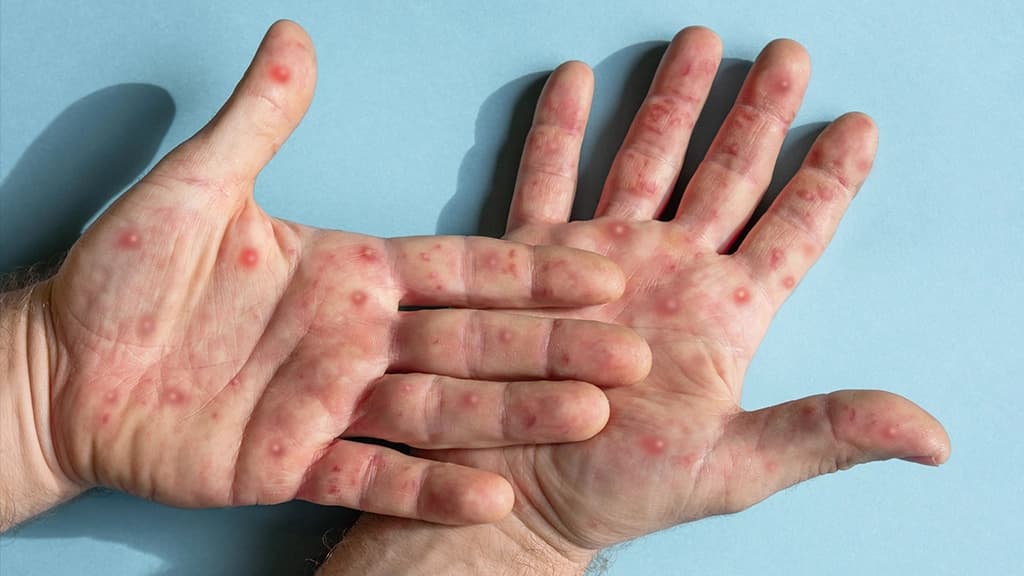
Symptoms: skin blisters (rash), fever, headache, swollen lymph nodes, muscle pain.
The names of the mpox types have been changed to avoid offending any cultural or ethnic groups and to reduce the negative impact on trade and tourism in African regions where the virus was first identified in 1958:
Mpox is primarily diagnosed through laboratory tests, with the PCR test (polymerase chain reaction) being the most commonly used. It is performed using samples collected from skin lesions, such as fluid from blisters or dried scabs.
There are similarities between mpox, smallpox, chickenpox and herpes, which can make differentiation difficult. Therefore, it is important to rely on the diagnosis of an infectious disease specialist who can accurately identify the illness and recommend appropriate treatment.
In suspected cases, it is essential to avoid close contact with others until symptoms disappear. Immediate isolation is recommended, and personal items such as towels and bed linens should not be shared.
In most cases, the infection does not require hospitalization, and treatment focuses on relieving symptoms and preventing the condition from worsening. Key treatment measures include:
Currently, there are no medications specifically approved for mpox. It is important to remember that any medication should be used under medical supervision.
The main way to prevent mpox is to avoid direct contact with infected individuals or contaminated objects. Key preventive measures include:
Ministry of Health (Brazil)
Fiocruz
MSD Manuals
Pan American Health Organization
Read health-related content and expand your knowledge:

A recurring skin inflammation. One of its forms is often mistaken for acne, commonly known as “pimpl [...]
A recurring skin inflammation. One of its forms is often mistaken for acne, commonly known [...]

A contagious disease caused by a virus from the Paramyxoviridae family, with symptoms such as fever, [...]
A contagious disease caused by a virus from the Paramyxoviridae family, with symptoms such [...]

Understand how they work in the body to prevent diseases [...]
Understand how they work in the body to prevent diseases [...]
A recurring skin inflammation. One of its forms is often mistaken for acne, commonly known as “pimpl [...]
A recurring skin inflammation. One of its forms is often mistaken for acne, commonly known [...]
A contagious disease caused by a virus from the Paramyxoviridae family, with symptoms such as fever, [...]
A contagious disease caused by a virus from the Paramyxoviridae family, with symptoms such [...]
Understand how they work in the body to prevent diseases [...]
Understand how they work in the body to prevent diseases [...]