Giving

Yellow Fever

Einstein Health Glossary

ICD 10 - A95

What is yellow fever?

Yellow fever is an acute viral disease caused by the yellow fever virus, which is primarily transmitted through the bite of infected mosquitoes. There are two types of yellow fever: urban yellow fever and sylvatic (jungle) yellow fever

  • urban yellow fever: historically, it was mainly transmitted by the Aedes aegypti mosquito in urban areas and was endemic in many tropical and subtropical regions of Africa and the Americas. However, thanks to vector control efforts and vaccination, urban yellow fever has been eliminated in many parts of the world
  • sylvatic (jungle) yellow fever: occurs in rural or forested areas and is primarily transmitted by Haemagogus and Sabethes mosquitoes. This form of the disease can be found in forested regions, especially in South America and Africa. Monkeys are often natural hosts of the virus, and humans can become infected when they enter forested areas where the virus is circulating

Symptoms

The symptoms of yellow fever can range from mild to severe and typically develop in three distinct phases: the initial (or febrile) phase, the remission phase, and the toxic phase. Not all patients go through every phase, and symptom severity can vary from person to person. Below are the common symptoms associated with yellow fever:

Fase inicial (febril)

  • sudden high fever
  • chills
  • severe headaches
  • muscle aches, especially in the back and abdomen
  • weakness and fatigue
  • nausea and vomiting
     

Remission Phase

Many patients begin to feel better after a few days, and symptoms temporarily subside. The fever decreases and may even disappear briefly. Patients may start to feel recovered, but in more severe cases, this is followed by the third phase of the disease

Toxic (Severe) Phase

In more serious cases, about 15% of patients enter the toxic phase of the disease, during which liver and kidney failure may occur. Symptoms can include:
  • jaundice (yellowing of the skin and eyes)
  • liver and kidney failure
  • hemorrhaging (bleeding from the skin, gums, nose, or gastrointestinal tract)
  • delirium
  • seizures
  • coma
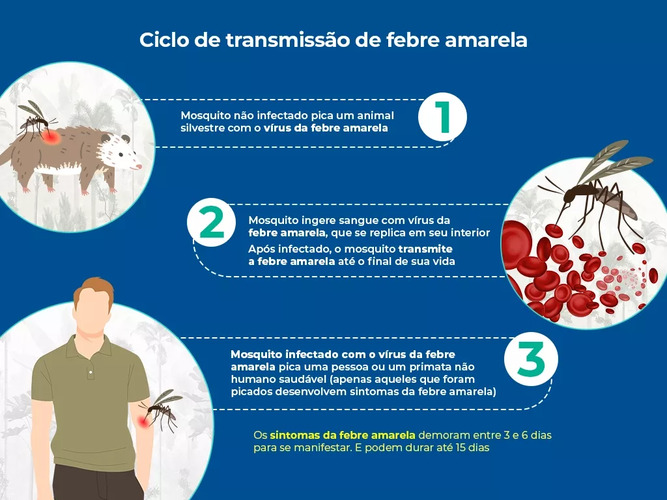
A imagem mostra o ciclo de transmissão da febre amarela. Ele é explicado em três etapas. O mosquito não infectado pica um animal silvestre infectado. Ao ingerir sangue com vírus, o mosquito é infectado pelo vírus da febre amarela. Na última fase, após picar uma pessoa ou primata saudável, o mosquito transmite a febre amarela.

Causes

Yellow fever is caused by the yellow fever virus (YFV), an arbovirus (a virus transmitted by arthropods) that belongs to the Flaviviridae family. The virus is primarily transmitted through the bite of infected mosquitoes

There are two main forms of yellow fever virus transmission:

  • Sylvatic (jungle) transmission: the virus circulates among non-human primates (NHPs) such as monkeys and is mainly transmitted by Haemagogus and Sabethes mosquitoes that live in forested and wild areas. Humans can become infected when they enter these forested areas and are bitten by infected mosquitoes. It’s important to note that NHPs are victims of yellow fever just like humans and should not be harmed. In fact, the death of monkeys in a given area serves as an alert for epidemiological surveillance teams to reinforce prevention measures for the population
  • Urban transmission: previously occurred mainly in urban areas and was transmitted by the Aedes aegypti mosquito, the same vector responsible for transmitting dengue, Zika virus, and chikungunya. However, urban yellow fever has been eliminated in many parts of the world due to effective mosquito control programs and mass vaccination. In Brazil, the last cases of urban yellow fever occurred in 1942. The presence of Aedes aegypti in Brazilian cities remains a warning sign for the potential reemergence of urban yellow fever

Diagnosis

The diagnosis of yellow fever typically involves a combination of clinical evaluation, the patient’s medical history, and specific laboratory tests. The main methods used to diagnose yellow fever include:

  • Clinical evaluation: the physician begins by assessing the patient’s symptoms, which may include fever, headaches, muscle pain, chills, nausea, vomiting, and jaundice (yellowing of the skin and eyes). The doctor also considers the patient’s recent travel history to areas where yellow fever is endemic
  • Laboratory tests: such as viral antigen detection tests, which can be performed to detect the presence of the yellow fever virus in the patient’s blood samples. This test is most useful during the acute phase of the disease, when the virus is actively circulating in the body
  • Serological tests: these can be used to detect the presence of specific antibodies against the yellow fever virus in the patient’s blood. These tests can help identify past or recent infections

Treatment

Currently, there is no specific treatment for yellow fever. Management is primarily supportive and aims to relieve symptoms, prevent complications, and ensure the patient’s recovery. Some common approaches used in the treatment of yellow fever include:

  • Hospitalization: patients with severe yellow fever or serious symptoms should be hospitalized for monitoring and intensive medical care
  • Hydration: fluid replacement is essential to prevent dehydration, especially in cases of vomiting and diarrhea. Patients may receive intravenous fluids to ensure proper hydration
  • Symptom management: medications may be administered to relieve symptoms such as fever, pain, and nausea

Prevention

The prevention of yellow fever primarily involves vaccination, vector control measures, and personal precautions to avoid mosquito bites. Some important prevention strategies include:

  • Vaccination: the yellow fever vaccine is highly effective in preventing the disease. Vaccination is recommended for people living in yellow fever endemic areas, travelers to those regions, and individuals involved in outdoor activities such as camping, hiking, and expeditions in forested areas. The vaccine is administered in a single dose and provides long-lasting immunity
  • Vector control: vector control measures aim to reduce the population of infected mosquitoes that transmit the yellow fever virus. This includes eliminating mosquito breeding sites such as containers with stagnant water, cleaning ditches, draining flooded areas, and using larvicides and insecticides
  • Personal protection: to avoid mosquito bites, it is important to take precautions such as applying insect repellent to exposed skin and clothing, following the manufacturer's instructions