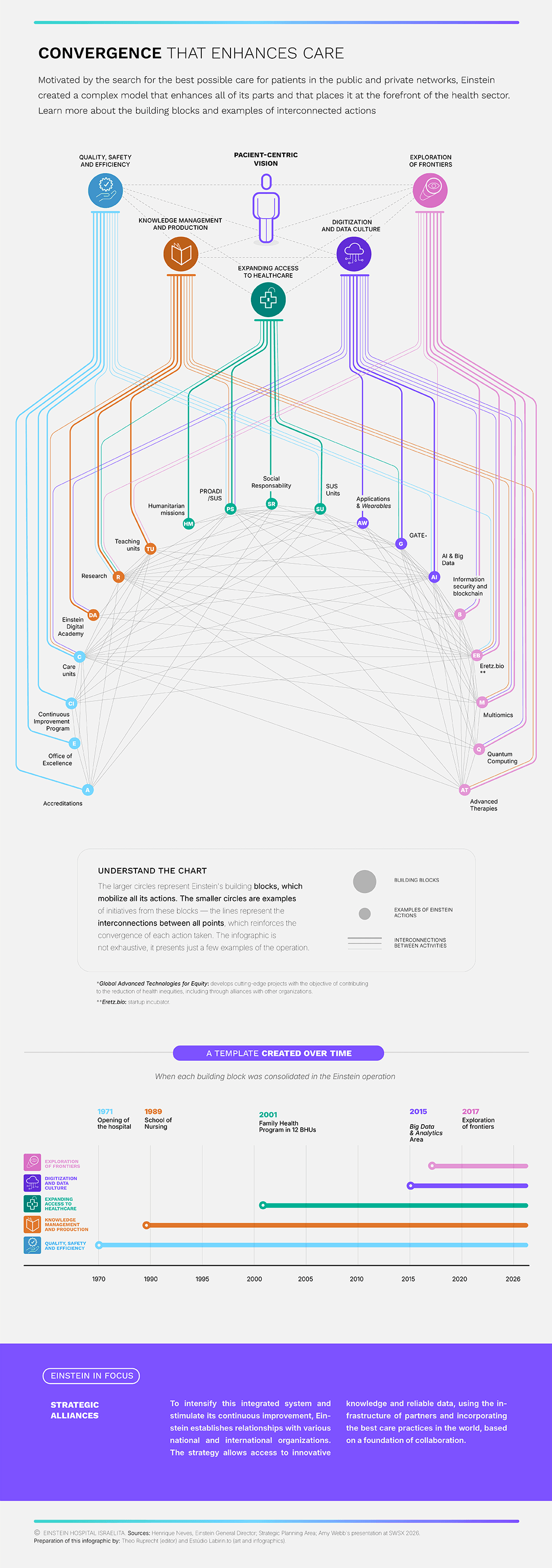
Einstein develops a unique environment that places it at the frontier of knowledge on different fronts of health care, bringing benefits to patients and professionals
Creating an environment that enhances and facilitates the patient journey – rather than walking through different health systems without support – is a goal of the most advanced health organizations. In one way or another, this vision has been part of the mission of the Einstein Hospital Israelita since its inception in 1955. Since then, innovation has only gained strength within the organization.
In 1986, in the midst of a revolution in imaging tests, Einstein became the first hospital in Latin America to have an MRI device (the second equipment in the region was also acquired by the organization). "It was a time when the organization showed its leadership in the introduction of new technologies," says Henrique Neves, Einstein general director.
By constantly acquiring and developing new health technologies, a center of excellence gets used to evaluating and reviewing its own processes in order to improve care. Then, a culture of continuous innovation is created in each activity, which benefits patients and health professionals, who end up using the most advanced technologies and processes.
“New technology often destroys previous ways of doing things. Einstein is used to this continuous process of rethinking its processes to seek excellence”
Henrique Neves, Einstein General Director
In the 2000s, the trend of creating health ecosystems was strengthened, with organizations making alliances and creating their own processes, products, and services to meet the different demands of the patient in a single environment. In view of this, Einstein went further and began to strengthen and diversify its portfolio with processes, services and products that, together, create synergy in favor of care.
For example: the organization today has robust areas for Teaching, Research and Innovation, and the experience of managing more than 30 SUS units. This results in clinical and care knowledge that circulates in an integral way, improves people's care and prepares professionals for the future.
Sidney Klajner, president of Einstein, concludes: “The strategy is to make our environment attractive so that the best ideas arise. We have everything necessary for this: public and private network patients, mentors, teachers, researchers, structure for technology validation, cutting-edge equipment, courses, investment capacity”.