Patients who enter through the same door, but who leave with personalized and high-quality care, focused on their health issues, demands and desires. This is how a hospital that looks to the future is designed. But how do we bring this vision into the present?
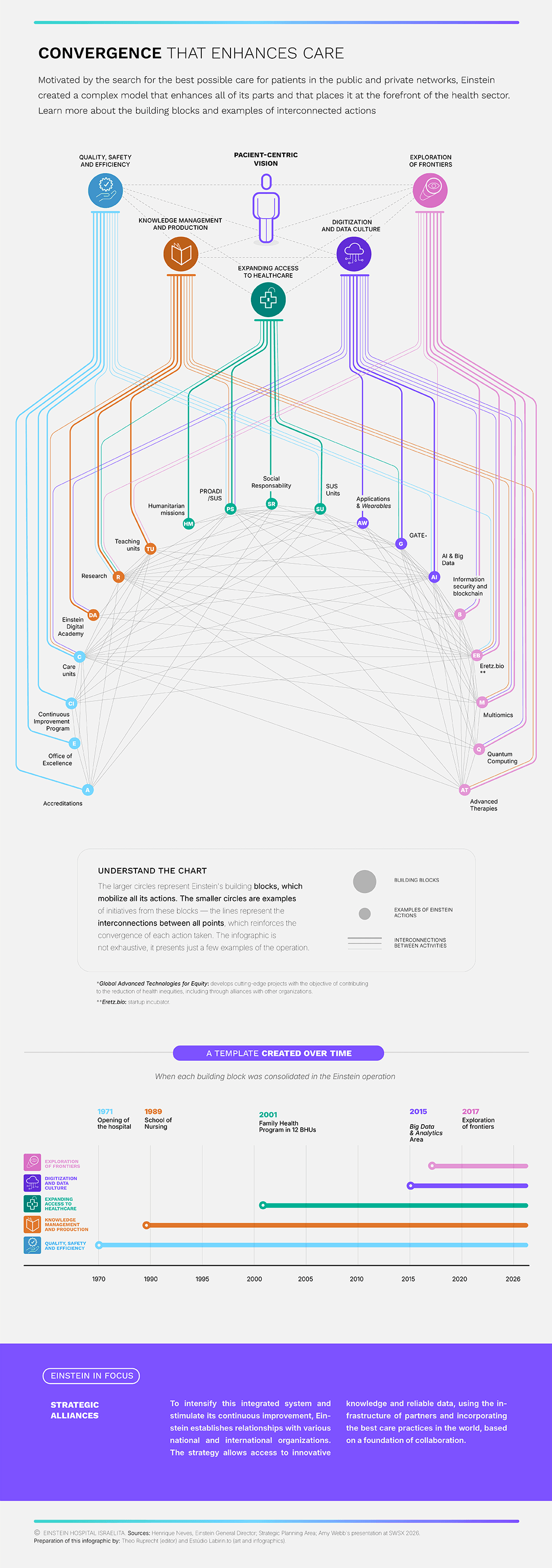
Einstein developed a unique model, anchored in building blocks that leverage each other. The first involves quality, efficiency, and safety in care. The organization has established processes that solve problems through objective and measurable actions.
The constant search for improvement made it clear that knowledge is a differential. Hence, the knowledge management and production platform was crystallized, with Research and Teaching areas.
However, continuous improvements and knowledge production required structured data — that's why Einstein invested in digitization and data culture, leveraging resources such as telemedicine and AI.
To remain at the forefront of technology, Einstein advanced in exploring frontiers, including an Innovation area that seeks to transform discoveries into safe and beneficial products. It also included in strategic planning a building block to expand access to health, which promotes activities in SUS.
These platforms, structured, connected and linked to daily actions, lay the foundations for Einstein to be, today, a Hospital of the Future.